Sheermal(Kashmiri sweet bread). Sheermal - A sweet Kashmiri Bread Recipe. by Nisha. Sheermal - A sweet Kashmiri Bread • The Magic Saucepan. Sheermal, is a mildly sweet bread made out of Maida, mixed with warm milk , sweetened with sugar and flavored with saffron.
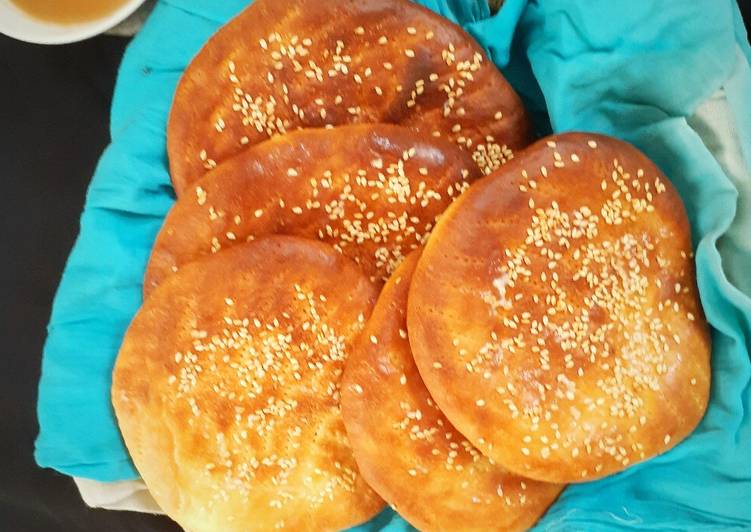 In Kashmir, there is a bread for every season.
It is a dry, crumbly bread with a long shelf life - salty as most kashmiri breads are.
There are various kinds of sheermal and certain places are famous for being fresh and crispy.
You can cook Sheermal(Kashmiri sweet bread) using 11 ingredients and 23 steps. Here is how you cook it.
In Kashmir, there is a bread for every season.
It is a dry, crumbly bread with a long shelf life - salty as most kashmiri breads are.
There are various kinds of sheermal and certain places are famous for being fresh and crispy.
You can cook Sheermal(Kashmiri sweet bread) using 11 ingredients and 23 steps. Here is how you cook it.
Ingredients of Sheermal(Kashmiri sweet bread)
- It's 2 of + 1/2 cup All purpose flour.
- It's 1/4 of th cup Milk powder.
- It's 1 teaspoon of dry active Yeast.
- It's 2 tablespoons of Sugar.
- Prepare 1/2 teaspoon of Cardamom powder.
- You need 1/2 teaspoon of Salt.
- You need 1/2 cup of Milk+ more for brushing or rubbing.
- Prepare 1 of Egg or 1/4th cup plain Yoghurt for a vegetarian option.
- Prepare 3 tablespoons of soft Ghee.
- You need 1 teaspoon of Kewra water.
- It's 2 teaspoons of or as required white Sesame seeds.
Sheermal or Shirmal (Persian-Urdu: شیرمال, Hindi: शीरमल), is a saffron-flavored traditional flatbread from Greater Iran. The word sheermal is derived from the Persian words شیر (translit. sheer) meaning milk, and مالیدن (translit. malidan) meaning to rub. Crispy and sweet, Sheermal is a Kashmiri food that can be easily prepared at home. The best way to learn the recipe and to relish the original taste of it is by visiting Kashmir and making this dish with the locals.
Sheermal(Kashmiri sweet bread) step by step
- Mix together yeast and sugar with 1/4th cup of warm water. Keep aside for 7-8 minutes to bloom the yeast..
- Mix together flour, milk powder and salt in a mixing bowl..
- When yeast mixture blooms add cardamom powder and kewra water..
- Also, add 1 egg or 1/4th cup of yoghurt to the yeast mixture..
- Make a hole in the centre of the flour mixture and add in the prepared yeast mixture..
- With your fingertips mix dry ingredient well with the wet ingredients..
- Add-in milk(normal temp) in batches and knead well to make a semi-hard dough..
- Spread the dough flat to a working surface..
- Spread soft ghee over the dough as shown in the picture..
- Now incorporate the ghee to the dough by dabbing and punching it with your hand..
- Fold the dough and again knead to well incorporate the ghee..
- Continue to knead to make a little soft and pliable dough..
- Cover the dough and keep aside for about 2 hours or until the dough becomes double in size..
- When the dough becomes double in volume, take out in a work surface and knead for few more minutes..
- Divide the dough into 5-6 portions..
- Preheat oven at 200 degree C for 10 minutes..
- Take one ball and roll into a thick chapati..
- Prick the chapati or disk as shown in the picture..
- Rub 2 teaspoon of milk on the surface of the chapati, sprinkle some white sesame seeds and place it on the baking tray..
- Similarly make all the chapatis or sheermal and place them on baking tray..
- Bake them in preheated oven at 200 degree C for about 15 minutes or until the breads become dark golden brown in colour..
- Sprinkle some milk and rub again the sheermal..
- Serve with a cup of tea, and if you can serve with Kashmiri pink tea then it will be perfect. These sheermal are little sweet, soft and crumbly delicious bread. You can store them in an airtight container for 2-3 days..
Read latest Sweet Bread articles, watch Sweet Bread videos and much more at NDTV Food. Sheermal, a slightly sweet and soft bread, is the perfect contrast to spiced but delicate stews of Awadh. This easy Sweet Bread recipe requires only staple ingredients: sugar, flour, baking powder, salt, eggs, milk and vegetable oil! Kashmiri breads—there are more than a hundred varieties today—can be traced to the second century, to Central Asia and the Silk Route. Sheermal is also available in both its sweet and savoury versions.
